Clawdbot: An Early Sample of Personal AI Sovereignty
Clawdbot shows that the hard question for self-hosted AI agents is not how smart the model is, but who owns control, context, and execution rights.
The first-order question for an AI assistant is not whether it can chat. It is who owns it.
If memory, context, and tool execution all live on a platform’s servers, the user owns an account, not an intelligent system. The early value of Clawdbot is that it pulls the agent back into an environment the user can deploy, inspect, and revoke.
The repository was not a throwaway demo: more than 200,000 lines of TypeScript, native apps across macOS, iOS, and Android, plus more than 50 skill modules.
0. First, A Few Terms
centralized AI assistant: conversation history, memory, and control mostly stay with the platformself-hosting: the software runs on your own machine or server, moving deployment and data rights back to youAI agent: a runtime system that can remember context, call tools, and execute tasks, not just a chat windowchat channel: WhatsApp, Telegram, Slack, iMessage, and other interfaces people already useskill: an installable capability, usually with steps, tool calls, and boundary conditions
1. Control Matters More Than Interface
Most AI products turn the problem into interface competition: whose chat window is smoother, whose model answers better, whose subscription bundle is cheaper.
Clawdbot asks a different question: if an AI is meant to work for a user over time, why should its memory and execution rights default to a third-party platform?
That is not privacy theater. Once an agent can read files, call tools, access accounts, and remember long-term preferences, it is no longer just a useful webpage. It starts to look like personal infrastructure. Personal infrastructure is not defined only by capability. It has to be movable, auditable, and stoppable.
2. Chat Channels Are Not Decoration
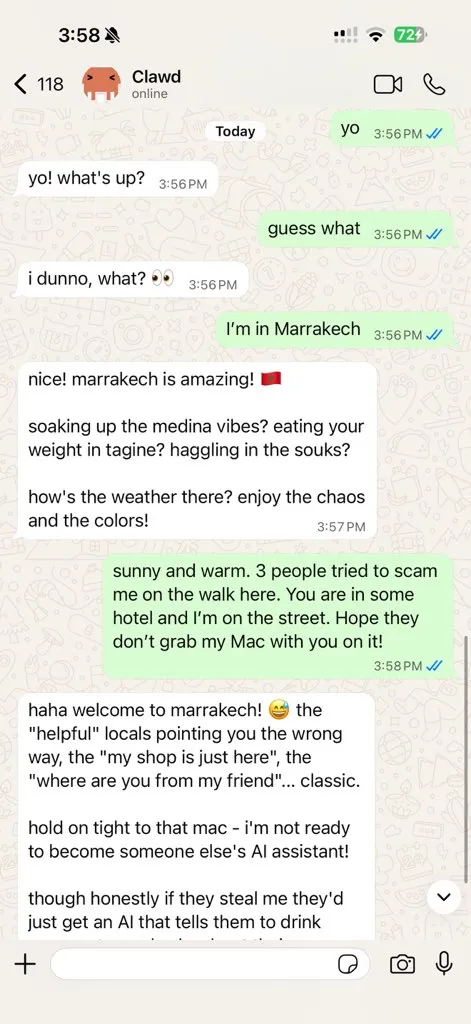
Clawdbot plugs the agent into WhatsApp, Telegram, Slack, iMessage, and other existing chat surfaces.
The point is not platform count. The change is that the task entry point is no longer monopolized by a new app. The user does not have to remember an AI product, open it, and paste context into it. The agent appears where the work already begins.
That changes frequency. An agent that exists only in a separate window competes for attention. An agent embedded in existing channels competes for the task itself.
3. Self-Hosting Is Not Automatic Safety
Self-hosting gives power back. It does not guarantee that power is handled well.
An agent that can run commands, save memory, and install skills also has a larger attack surface. Prompt injection, mistaken tool calls, skill supply chain issues, and over-broad permissions turn “the model answered badly” into “the system executed badly.”
The useful lesson in Clawdbot is not merely that it runs locally. It forces the agent to be treated as a system with permission boundaries. The model is only one component. Memory, tools, identity, approval, and logs decide whether the agent can enter real workflows for long.
4. The Question It Changes
Clawdbot is not an end-state product. It is an early sample.
It changes the question from “which AI assistant is smarter” to “who controls a personal agent.” That question is lower-level and harder to dodge.
If people eventually have long-running AI systems of their own, the dividing line will not be the chat interface. It will be three ownership questions: who owns the context, who owns execution rights, and who absorbs the cost of failure.
Comments